If you are visiting Iran, one of the first Persian words you will hear is Sepas ; the Farsi way to say “thank you.” You may also hear “Merci,” a French loanword widely used in daily conversations. In this guide, you will learn the meaning of Sepas, Sepasgozaram, and why Iranians use the French “Merci” more than English “thank you.

How Merci Traveled from France to Persia?!
Do you have any idea how many French words we use in our language? Here, you can have a complete list of French words imported into Farsi.
The first point of cultural exchange between Iran and Europe started during the Qajar period when the Qajar kings started to travel to Europe. They were astonished by the European lifestyle and wanted to mimic some European lifestyle in Iran. This influence can be seen in architecture and language.
Moreover, Sending and funding high-class families’ children for education in Europe, especially French universities, gradually impacted cultural exchange in society since most of the graduated students returned to Iran and worked as politicians, ministers, or representatives in parliaments.
To show off their knowledge, they used lots of French words, which resulted in importing lots of loan words from French to Farsi. The influence of the French language in Farsi was so dominant until the 1920s when the second language of schools was changed from French to English.
What Do “Sepas” and “Sepasgozaram” Mean in Farsi?
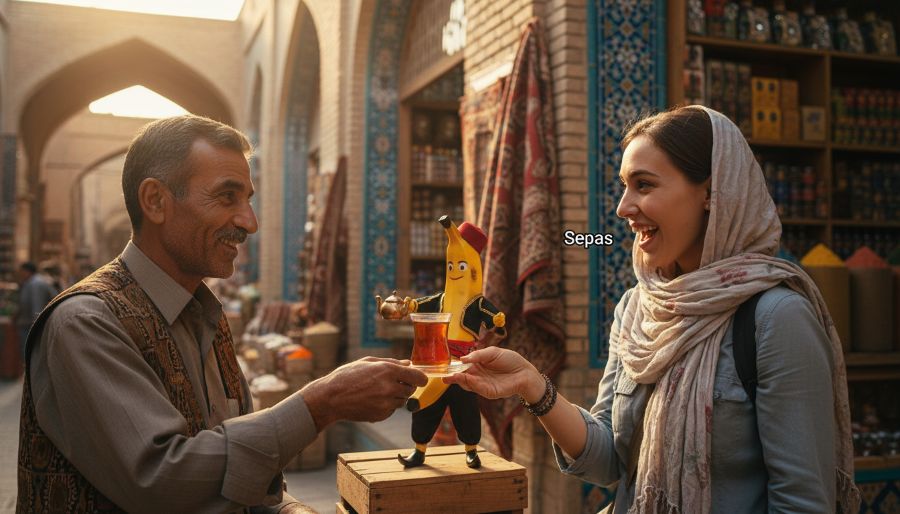
Sepas is the most common and natural way to say “thank you” in Farsi. It is short, polite, and works in almost every situation—from thanking a shopkeeper to showing appreciation to a friend. A more formal and heartfelt version is Sepasgozaram, which literally means “I am grateful.” While Iranians rarely use it in very casual conversations, it is perfect when you want to sound respectful, polite, or appreciative. Both expressions are widely understood, and for travelers, learning these two words is one of the easiest ways to connect with locals.
Other Common Ways to Say Thank You in Farsi
Besides Sepas and Merci, Iranians commonly use the words Mamnoon and Kheili Mamnoon in daily conversations. Mamnoon means “thankful” or “grateful,” and it has a warm, friendly tone that you will hear everywhere in Iran. If you want to say “thank you very much,” you can use Kheili Mamnoon, which literally means “very thankful.” Another polite and widely used expression is Moteshakeram, which is slightly more formal and can be used with strangers, shopkeepers, or in any respectful interaction. These expressions offer different levels of politeness, but all of them are perfect for travelers to use in everyday situations.
| Persian Word | Phonetic (Latin) | Meaning | Formality / Tone |
|---|---|---|---|
| سپاس (Sepas) | se-pās | Thank you | Neutral |
| سپاسگزارم (Sepasgozaram) | se-pās-go-zā-ram | Thank you very much / I am grateful | Formal |
| مرسی (Merci) | mer-see | Thanks | Informal, friendly |
| ممنون (Mamnoon) | mam-noon | Thankful / thanks | Informal, warm |
| خیلی ممنون (Kheili Mamnoon) | khey-lee mam-noon | Thank you very much | Informal to neutral |
| متشکرم (Moteshakeram) | mo-te-sha-ke-ram | I appreciate it / thank you | Formal / polite |
| دستت درد نکنه (Dastet Dard Nakoneh) | das-tet dard na-ko-ne | Thank you | Informal / Phrase |
Join us on our daily free walking tours, and our storytellers will tell you nice stories about culture. Also, we teach you some useful Farsi or Persian words like Sepas!
How to “Answer Thank You” in Farsi?
Understanding how to reply when someone thanks you is an essential part of communicating politely during your Iran trip. Whether your tour guide thanks you for the payment, a hotel receptionist appreciates you for completing check-in forms, or a local shopkeeper expresses gratitude, knowing the right Persian responses will help you interact more naturally.
khahesh mikonam = You’re Welcome
The most common and useful reply to “thank you” in Persian is (khahesh mikonam), meaning you’re welcome.
ghābeli nadāre = it’s nothingit’s nothing
You may also hear and use friendly alternatives such as (ghābeli nadāre), a modest phrase meaning it’s nothing.
ekhtiār dārid= You’re Welcome
Ekhtiār dārid also conveys respect and politeness. These phrases are widely used in everyday service interactions across Iran.
Learning how to respond to “thank you” in Persian not only makes communication smoother but also shows cultural awareness, helping you create warmer connections throughout your journey in Iran.
How to say “Thank You” in Farsi — Quick FAQ
Short answers and pronunciations for the most common Persian thank-you expressions. Tap or press enter on a question to expand.
Short answer: The most common word is Sepas (سپاس).
Use: Sepas works in casual and neutral settings. A formal, more emphatic form is Sepasgozaram (سپاسگزارم) which literally means “I am grateful.”
| Word | Phonetic | Meaning |
|---|---|---|
| سپاس / Sepas | se-pās | Thank you |
| سپاسگزارم / Sepasgozaram | se-pās-go-zā-ram | Thank you very much / I am grateful |
Short answer: Merci (مرسی) is a loanword from French and became common because French was a dominant second language in Iran during the Qajar and early Pahlavi periods.
Use: It’s informal and widely used in everyday conversation; think of it as the Persian equivalent of “thanks.”
No — Merci is considered informal and friendly. For more polite or formal moments, use Sepasgozaram or Moteshakeram.
Moteshakeram (متشکرم) is a formal, polite way to say “I appreciate it.” Sepas is neutral and fine for everyday use; Sepasgozaram is polite and slightly more formal than Sepas.
Yes. Common alternatives include:
- ممنون / Mamnoon — mam-noon — warm, casual “thanks”.
- خیلی ممنون / Kheili Mamnoon — khey-lee mam-noon — “thank you very much”.
- متشکرم / Moteshakeram — mo-te-sha-ke-ram — formal “I appreciate it”.
These expressions cover informal to formal situations and are useful for travelers.